Why Indian Therapists Need Practice Management Software in 2026
Why running an Indian therapy practice on WhatsApp threads, spreadsheets, and Google Calendar is quietly costing you clients, income, and hours — and what a WhatsApp-native practice management system like MyndSpace's Kiara actually changes.

Why Indian Therapists Need Practice Management Software in 2026#
If you're a therapist, psychologist, or counsellor practising in India today, your practice looks very different from what it looked like even three years ago. Clients discover you on Instagram. They message you on WhatsApp at 11pm. They pay you via UPI in seconds. They expect a booking link, a Google Meet invite, an intake form, a reminder the day before, and a gentle nudge for the next session — all without ever picking up a phone.
Meanwhile, most Indian practices are still being run out of a Google Calendar, a Notes app, a chaotic WhatsApp inbox, and a shared Google Sheet that nobody wants to open on a Monday morning.
Something has to give. In 2026, it usually does — and it's usually the therapist.
This is a guide to why that's happening, what a proper practice management system actually does, and what to look for when you finally decide to stop stitching five apps together to run a real clinical business.
The Indian Therapy Market Has Grown Up. Its Tooling Hasn't.#
Demand for therapy in India has exploded. Mental health is no longer taboo in urban India; it's a line item in HR budgets, a talking point on podcasts, a search term with real intent behind it. New practitioners are entering the field every month. Established therapists are seeing waitlists they've never seen before.
But growth without infrastructure is just chaos with more clients.
Ask any independent therapist in Mumbai, Bangalore, Hyderabad, or Delhi what their week looks like, and the pattern is familiar:
- 30% of their time is spent on actual therapy.
- The other 70% goes into replying to booking messages, sending reminders, chasing payments, remembering who cancelled what, and manually creating Google Meet links.
That's not a therapy practice. That's a customer support job with a therapy practice buried inside it.
The Hidden Cost of "Managing It Manually"#
Most therapists don't fully see the cost until they add it up. Here's what running a practice on WhatsApp, Sheets, and memory actually looks like when you total the leakage.
1. Booking friction is silently costing you clients#
A prospective client messages you on Instagram at 11:47pm asking if you have a slot. You reply at 9am the next day. By then, three things have happened: they've cooled off, they've messaged two other therapists, or the moment of courage that pushed them to reach out has passed.
Every hour of delay between "interest" and "confirmed booking" leaks clients. A shared booking link that shows real availability closes that gap to zero.
2. No-shows and last-minute cancellations are eating your revenue#
The industry benchmark is 15–20% no-shows without automated reminders. In a practice doing 40 sessions a month at ₹1,500–₹3,000 per session, that's ₹9,000–₹24,000 leaking out every single month. Every. Single. Month.
3. Follow-ups are where retention actually lives#
Most therapists think retention is about how good the sessions are. It's not. Good sessions are table stakes. Retention lives in the two-week gap between sessions — the space where a client either books the next one or drifts away. A gentle, professional follow-up in that gap is often the difference between a client who comes back for six months and one who ghosts after two sessions.
Almost no therapist does this consistently. Not because they don't care — because they're human, and humans forget.
The data on this is striking. On MyndSpace, WhatsApp follow-up messages for rebooking hit a 45% click-through rate — roughly 24 percentage points higher than what generic booking apps like Goldie see for the same category of message. That gap is entirely about context: a nudge from your therapist's practice on WhatsApp, sent at the right moment, is a fundamentally different signal than a generic booking reminder. And it's why 60% of clients on MyndSpace go on to book another session — a number that most independent practices would need to hire a part-time coordinator to hit manually.
4. Payment chasing is exhausting and unprofessional#
Sending a UPI QR code screenshot, waiting for a payment screenshot back, cross-checking against your ledger, remembering who still owes for last month — this is not the experience clients paying ₹2,000+ per session expect in 2026. It also isn't the experience you signed up for when you decided to become a therapist.
5. Admin is why you're tired#
Burnout in Indian therapists isn't primarily about hard sessions. It's about the invisible admin tax on top of the sessions. The mental load of remembering, coordinating, chasing, and switching between five apps is what actually breaks people.
Why Indian Therapists Have Unique Requirements#
International practice management tools exist — SimplePractice, Jane, TherapyNotes. They're beautiful. They also don't work for India.
Here's what an Indian practice specifically needs that global tools don't handle well:
WhatsApp is not optional. In India, WhatsApp isn't a "communication channel." It's the communication channel. Any tool that expects your clients to check email for appointment reminders is going to disappoint you. Reminders, follow-ups, booking confirmations, reschedule notifications — all of it has to happen on WhatsApp, or it doesn't happen at all.
UPI is not optional either. Cards are for luxury purchases. UPI is for everything else. If your billing flow doesn't gracefully handle UPI, you're going to be sending QR codes forever.
Google Calendar sync matters more than you think. Many Indian therapists work with EAPs like Spring Health, Amaha, or Lyra alongside their private practice. Those platforms drop sessions into your Google Calendar. Any practice management tool that doesn't sync bidirectionally with Google Calendar will double-book you within a week.
Hybrid practice is the norm. Most Indian therapists run some sessions online, some in-person, sometimes on the same day. You need a system that treats online and offline slots as first-class citizens — different rules, different durations, different pricing.
Multi-currency, multi-timezone. A growing number of Indian therapists serve NRI clients across the US, UK, UAE, and Singapore. Your tools need to support that without a spreadsheet workaround.
Language and price sensitivity. Global tools charge $49–$99/month. That math doesn't work for a therapist doing 20 sessions a month at ₹1,500 each. Indian therapists need Indian pricing.
What Real Practice Management Software Actually Does#
Forget features for a second. Here's the outcome a proper system should deliver:
You should never touch a booking again. A prospective client should be able to see your real availability, pick a slot, get a confirmation, receive a reminder, get a Google Meet link, and show up — without you doing anything.
No-shows should drop by half or more. Automated WhatsApp reminders 24 hours and 1 hour before a session are the single highest-ROI thing in a therapy practice. Nothing else even comes close.
Follow-ups should happen automatically. Every client should get a gentle nudge after their session, and another one when it's time to book the next. Not because you're being pushy — because your clients want to come back, and they need the invitation.
Payments should be quiet. UPI links should go out with the confirmation. Payments should reconcile themselves. You should not know or care about the mechanics.
Notes should be secure and searchable. Encrypted, HIPAA-aligned, and available on your phone before your next session so you can quickly refresh your memory on where you left off.
Insights should tell you what to do next. Not just "here's your revenue" — but "you have three underused Wednesday slots; opening them could grow your revenue by 15%."
That last one is the shift. In 2026, practice management software isn't just an admin tool anymore. It's a co-pilot.
What to Look For When You Choose a Tool#
Here's a checklist. Whether you evaluate MyndSpace, PractiPal, or something else — hold every tool to these standards:
- WhatsApp-native, not WhatsApp-optional. Reminders, follow-ups, booking confirmations must go via WhatsApp.
- UPI billing built in. Not as an add-on. Not with a 4% fee. Built in.
- A public booking page you can embed anywhere — your website, your Google Business listing, your Instagram bio, a WhatsApp forward.
- Two-way Google Calendar sync that plays nicely with EAP platforms.
- Automated Google Meet link generation for every online session.
- Independent online and offline slot rules.
- Paperless intake and consent via a client portal — no more PDFs over email.
- Session packages so you can offer 5-session or 10-session bundles at a discount.
- HIPAA-aligned data storage with encryption and audit trails.
- Multi-therapist support if you're building a clinic.
- Revenue and retention analytics — not vanity dashboards, but numbers that suggest next actions.
- Priority WhatsApp support for you as the therapist. If you have a problem at 8pm on a Sunday, you need someone reachable.
- Fair Indian pricing. Under ₹1,500/month for a solo practitioner. Anything more is a global tool with a rupee sign glued on.
Meet Kiara: The Practice Assistant Built for Indian Therapists#
At MyndSpace, we've spent 2025 and 2026 building exactly this system with a community of Indian therapists — and we call her Kiara.
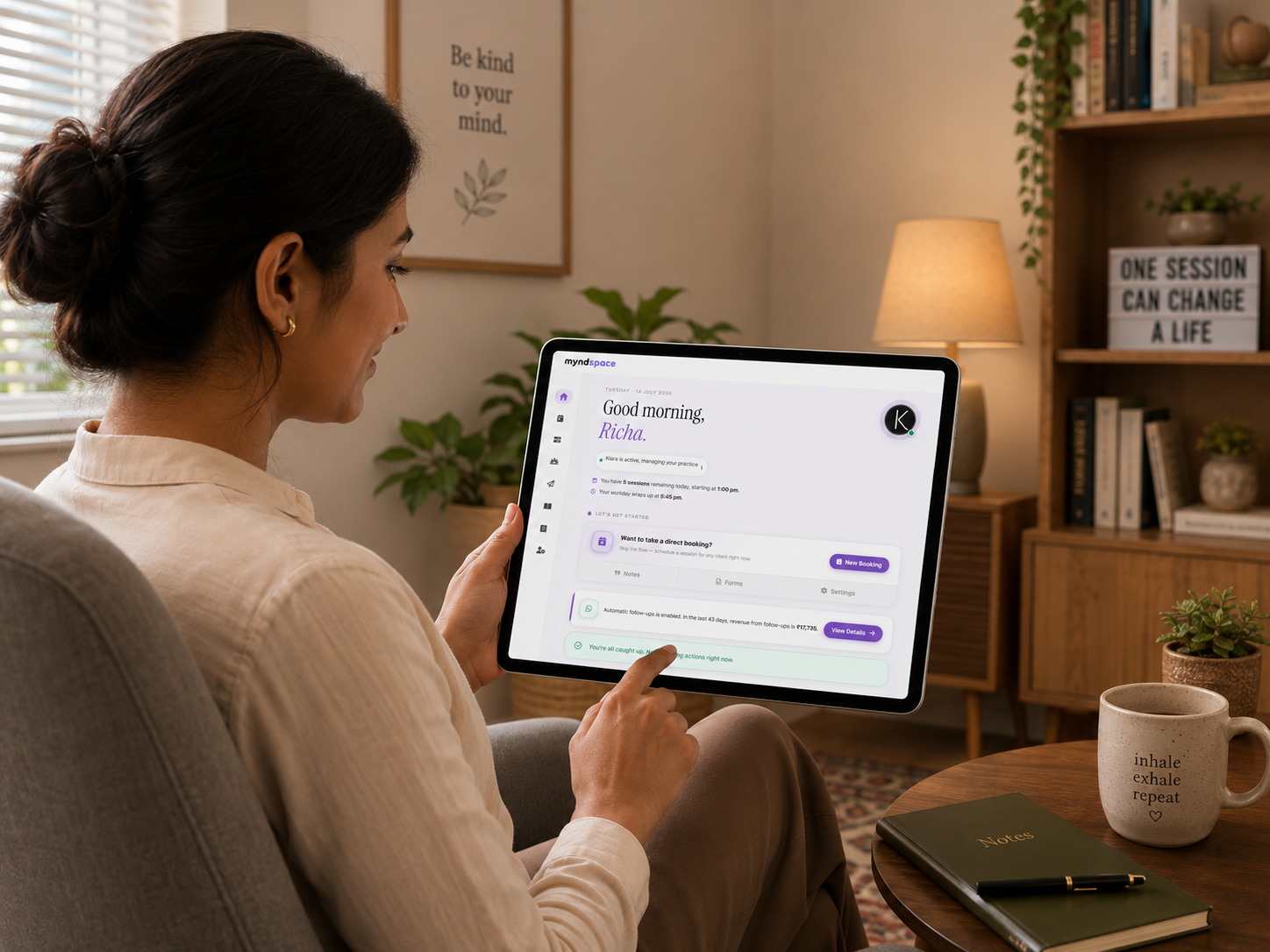
Kiara is your intelligent clinical assistant. She's not a "software product" in the way you're used to thinking about software. She runs your practice in the background — taking bookings, managing your calendar, sending WhatsApp reminders, following up with clients, tracking payments, and surfacing insights about your revenue and retention. She notifies you only when you need to take action.
This isn't hypothetical. Between March and June 2026 alone, more than 1,155 therapy sessions were booked through MyndSpace — over 2,000 hours of therapy, 542 unique clients, and close to ₹18 lakh in payments flowing through the platform. That's four months. The underlying story is a small network of independent Indian therapists getting back the hours they used to spend on admin, and turning that into more sessions, more clients, and more revenue.
A few things that make Kiara different:
- She builds your booking portal from your real availability — one link you can drop on your website, Google listing, or WhatsApp bio. Clients book. You don't reply. It just works.
- She runs on WhatsApp. Every reminder, confirmation, reschedule, and follow-up goes to your client via WhatsApp. No missed emails.
- She handles hybrid practices out of the box — separate slot rules for online and in-person, with auto-generated Google Meet links for online sessions and Google Calendar sync so you never double-book with an EAP.
- She follows up with your clients so you don't have to. 60% of clients on MyndSpace book another session — driven by gentle, automatic WhatsApp nudges that clients actually open. Therapists in the network see roughly ₹12,000/month in additional repeat revenue, on average, without lifting a finger.
- She shows you where the money is. Kiara projects your monthly revenue and tells you specifically what to do — which slots to open, which days to reprice, where you're leaving money on the table.
- She supports international clients — multiple currencies, multiple timezones, no spreadsheet workarounds.
- She sets up in 5 minutes. Not a marketing claim. An actual guided onboarding that pulls your existing practice in without you rebuilding anything.
Pricing is designed to be embarrassingly reasonable: ₹699/month for Lite (up to 30 sessions), ₹1,199/month for Pro Unlimited (unlimited sessions, unlimited clients, multi-therapist support, and the full Kiara AI assistant), or ₹799/month on the annual plan. Every plan includes a 30-day free trial with no card required.
The Bigger Point#
You didn't become a therapist to run a small business operations team out of your head.
In 2026, the therapists who thrive won't be the ones who work harder on admin. They'll be the ones who stop doing admin at all — and let a well-designed system do it for them. The hour a day you get back isn't just "time saved." It's the difference between burning out in year four and building a practice that lasts twenty.
If any part of this article felt like it was describing your Tuesday, it's probably time.
Ready to see it in action? Start your 30-day free trial — no card required, five-minute setup — or book a demo on WhatsApp and we'll walk you through it live.
MyndSpace is the WhatsApp-native practice management platform built with and for Indian mental health professionals. HIPAA-aligned. 250+ therapists across Mumbai, Pune, Bangalore, Hyderabad, and beyond. Made with care in India.